


Editorial | The Biz Reporter
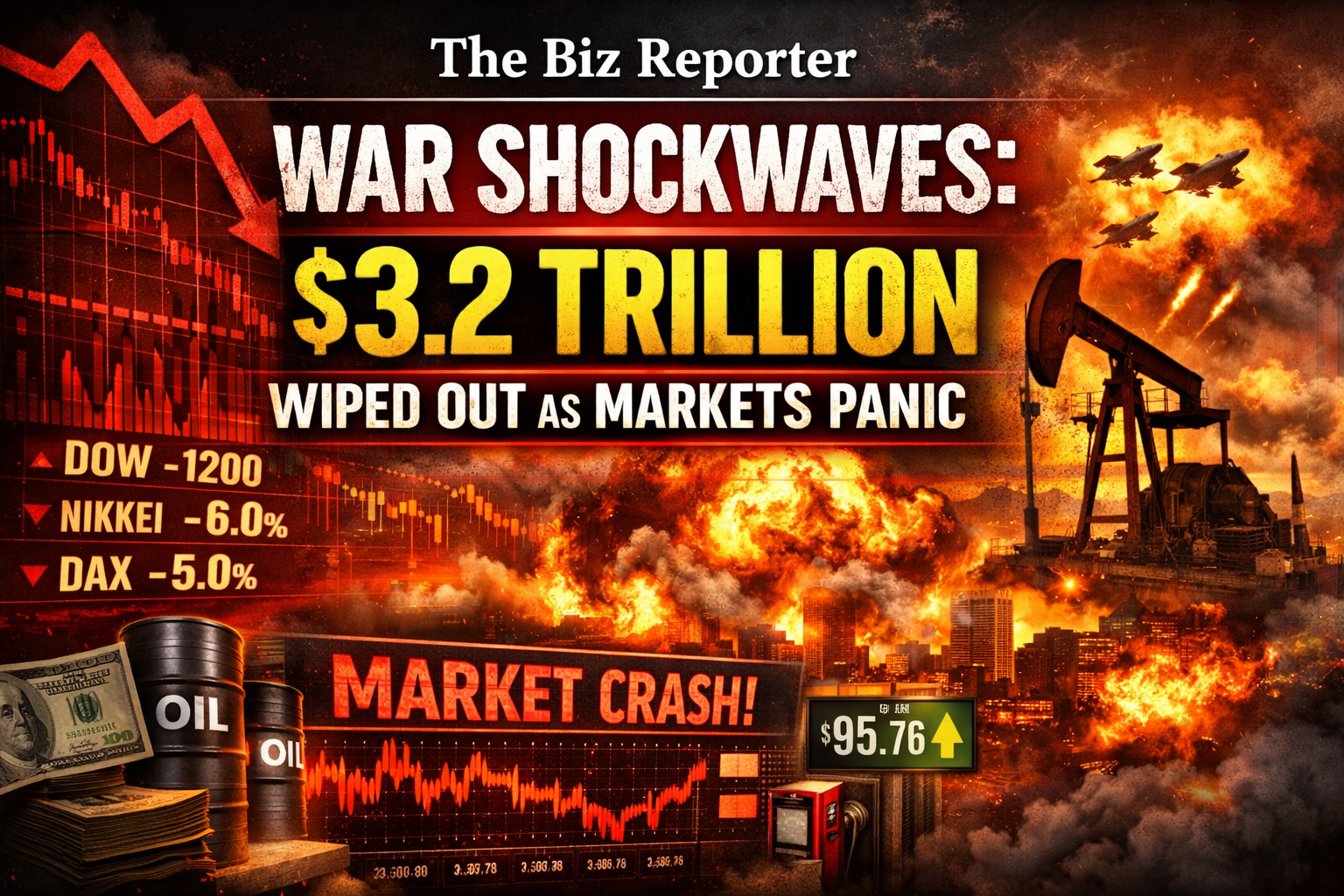
Global financial markets are reeling under the impact of an escalating Middle East conflict that has rapidly transformed into one of the most severe geopolitical shocks in recent decades. In just four days, an estimated $3.2 trillion in global market value has been wiped out, as investors across continents rush to reassess risk amid intensifying war and energy supply disruptions.
The scale of the market reaction is extraordinary.
South Korea’s stock market plunged nearly 8 percent, triggering a circuit breaker that forced authorities to temporarily halt trading — a rare mechanism designed to stop panic selling when markets crash too rapidly. Such measures are typically associated with moments of extreme financial stress.
But the shock has spread far beyond Seoul.
Across Asia, Europe and the United States, markets have recorded steep declines. Japan’s benchmark index fell 6 percent, Germany dropped 5 percent, Spain slid 4.5 percent, and Italy declined 4 percent. In London, the FTSE index lost 2.75 percent, while in the United States the Dow Jones Industrial Average plunged by more than 1,200 points, marking its sharpest fall since April 2025. The Nasdaq also tumbled by roughly 500 points, reflecting broad investor anxiety.
Energy Shock at the Center
At the heart of the financial turmoil lies a sudden and severe disruption in global energy supply.
The Strait of Hormuz, through which nearly 20 percent of the world’s oil supply passes, has reportedly been shut amid the widening conflict. Simultaneously, key energy infrastructure across the Middle East has been severely affected.
Saudi Arabia’s largest refinery has reportedly been hit, Qatar’s liquefied natural gas production has halted, and one of Iraq’s major oil fields has been shut down. Together, these disruptions are sending shockwaves through global energy markets.
Oil prices have already surged above $85 per barrel and are edging toward the $100 mark, raising fears of a renewed global energy crisis reminiscent of the 1973 oil shock, which plunged the world economy into years of turbulence.
In Europe, the impact is already visible. In the United Kingdom, wholesale gas prices have surged 74 percent in just two days, reflecting the sudden tightening of supply and mounting uncertainty about future energy flows.
Inflation Risks Resurface
The surge in energy prices could have far-reaching consequences for the global economy.
Energy costs influence nearly every sector — from transportation and food production to manufacturing and household heating. As oil and gas prices rise, businesses often pass those costs on to consumers, increasing the risk of a renewed wave of inflation just as central banks had begun to see signs of price pressures easing.
Financial markets are already adjusting expectations. The probability of a Bank of England interest rate cut has plunged from 80 percent to just 29 percent within a week, as investors increasingly believe policymakers may be forced to keep borrowing costs higher for longer.
For households already struggling with elevated living costs, this could mean another round of rising prices for fuel, groceries and essential goods.
Escalation on the Ground
The economic turmoil is unfolding alongside rapidly escalating military developments in the Middle East.
Hundreds of casualties have been reported in Iran, while the conflict has expanded across multiple fronts. Israeli forces have reportedly entered Lebanon, and major cities such as Tehran and Beirut have come under intense bombardment.
Reports that Iran’s Supreme Leader has been killed have further heightened tensions, raising concerns that the conflict could deepen and spread across the region.
Meanwhile, Washington has indicated that the war could continue for four to five weeks, suggesting that the current financial turmoil may only represent the early phase of a potentially prolonged geopolitical crisis.
Markets Confront Uncertainty
History offers sobering reminders of how geopolitical shocks tied to energy supply disruptions can reverberate through the global economy.
The 1973 oil crisis triggered years of inflation and economic stagnation, while the 2008 global financial crisis erased trillions of dollars in wealth and reshaped financial systems worldwide.
Whether the current crisis evolves into a similar global downturn remains uncertain. What is clear, however, is that financial markets are reacting not only to present events but also to the growing fear of what may lie ahead.
If energy disruptions persist and geopolitical tensions escalate further, the world could face a dangerous combination of rising inflation, slowing economic growth and prolonged market volatility.
A Defining Moment
The events unfolding today highlight the deep interconnection between geopolitics and global finance. Wars fought in strategic regions can rapidly reshape markets, supply chains and economic expectations across the planet.
For governments, investors and citizens alike, the coming weeks may prove critical.
Markets may eventually stabilize. But until the geopolitical storm begins to clear, uncertainty — and volatility — are likely to remain the defining features of the global economy.
— Editorial Desk
TheBizReporter.com


