


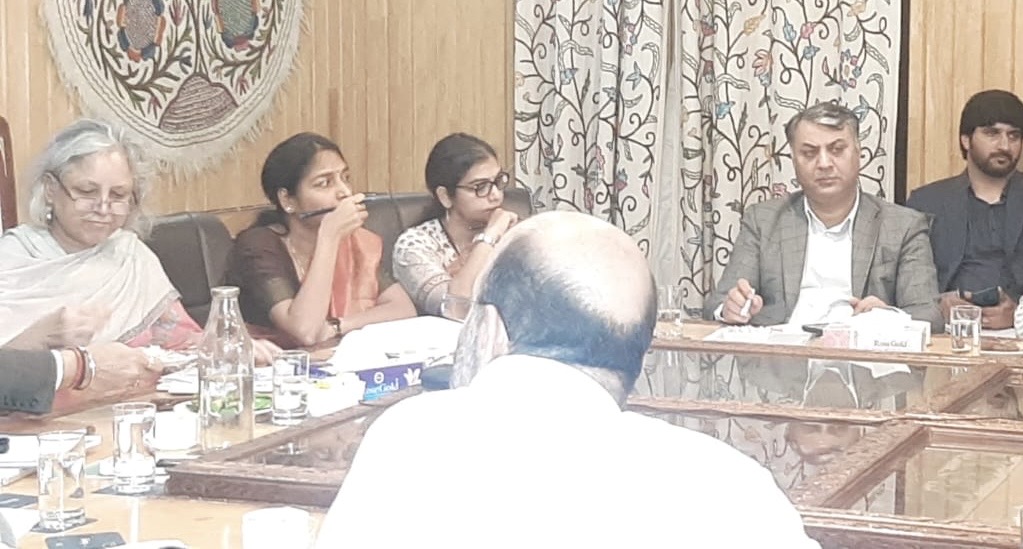
Srinagar, September 9: The President of the Kashmir Chamber of Commerce & Industry (KCCI), Mr. Javid Ahmad Tenga, on Tuesday participated in an interaction with Ms. Neelam Shami Rao, Secretary, Ministry of Textiles, Government of India, at the Government Arts Emporium, Srinagar, where he highlighted a range of critical issues confronting the handicrafts sector of Jammu & Kashmir.
The meeting was also attended by senior officials of the Ministry of Textiles, Commissioner Secretary Industries and Commerce Vikramjeet Singh, and Director Handicrafts and Handloom Musurrat Islam.
At the outset, Mr. Tenga welcomed the GST Council’s decision to reduce GST on handicraft items from 12% to 5%, appreciating Prime Minister Narendra Modi’s vision behind the move. He noted that Kashmiri handicrafts, with a legacy spanning over 600 years since the arrival of Shah-e-Hamdan (RA), provide direct livelihood to more than 3.8 lakh artisans.
Warehousing & Exports
The KCCI President reiterated the Chamber’s demand for a dedicated warehousing facility for Kashmiri handicrafts at Dubai Mart, a matter already taken up with Union Commerce & Industry Minister Shri Piyush Goyal. He flagged the decline in exports from Kashmir and stressed the need for greater participation of artisans and exporters in domestic and global fairs, particularly Reverse Buyer-Seller Meets (RBSMs). He also proposed hosting a Buyer-Seller Meet in Srinagar in collaboration with export councils, saying it would both strengthen handicrafts and revive tourism hit by recent incidents in Pahalgam.
Financial Support & ROSCTL
Raising the issue of financial stress on exporters, Mr. Tenga called for the reintroduction of the 3% interest subvention on export finance for small exporters and artisan businesses. On ROSCTL, he criticised the current cap of Rs. 438 per piece on woollen and Pashmina shawls (HS Code 62142010), pointing out that authentic handmade shawls fetch between Rs. 7,000 and Rs. 1,00,000. Equating premium handmade products with low-value items, he argued, distorts policy and undermines competitiveness. KCCI demanded removal of the cap and restoration of FOB-based incentives as earlier provided under MEIS. The Secretary assured that a representation from KCCI on this issue would be duly considered.
Cluster Recognition
Mr. Tenga underlined the success of Kanihama (Budgam) after its recognition as a Handloom Village, and urged similar recognition for other craft-rich areas. He proposed declaring North Kashmir’s globally renowned silk carpet belt as a “Carpet Cluster” and extending cluster recognition to other artisan-dense districts for targeted development.
Global Outreach
Stressing that Europe and the Middle East remain core markets for Kashmiri crafts, Mr. Tenga urged the government to facilitate structured market study tours and trade delegations to expand exports. The Secretary of Textiles encouraged KCCI to submit a detailed proposal identifying priority countries for such initiatives.
The interaction concluded with an assurance from the Secretary that all issues raised by KCCI would receive serious consideration in policy planning for the handicrafts sector.


