


The Biz Reporter
Here’s a polished, reader-friendly edited version of your report with the headline you suggested:
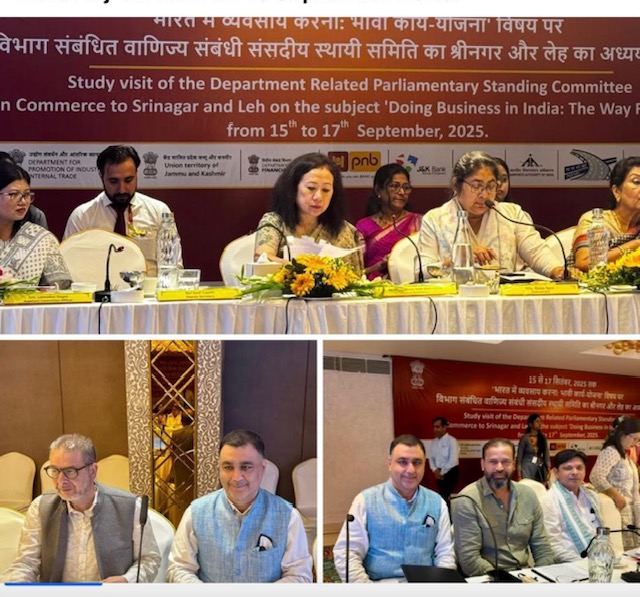
Srinagar, Sep 15: A delegation of the Kashmir Chamber of Commerce and Industry (KCCI), led by Senior Vice President Ashiq Hussain Shangloo and Joint Secretary General Umer Nazir Tibetbaqal, held a constructive and wide-ranging meeting today with the Parliamentary Standing Committee on Commerce, headed by its Chairperson, Ms. Dola Sen.
The meeting was part of the Committee’s visit to the Union Territory and was attended by Members of Parliament including Smt. Renuka Chowdhury, Shri Awasthi Ramesh, Mr. Yusuf Pathan, Dr. Shiv Pal Singh Patel, Mr. Sadanand Mhalu Shet Tanavade, Mr. Santosh Panday, Shri Prasun Banerjee, Dr. Prashant Yadaorao Padole, among others.
The KCCI delegation presented a detailed memorandum highlighting pressing concerns and offering recommendations aimed at strengthening commerce, trade, industry, and exports in Jammu and Kashmir.
The delegation expressed concern that despite the Government of India’s emphasis on Ease of Doing Business, entrepreneurs in J&K continue to face bureaucratic delays and cumbersome procedures. They said approvals for business operations take several months, and hoteliers are compelled to secure multiple no-objection certificates (NoCs) from different departments. By the time one NoC is obtained, another often expires, creating an endless cycle of hurdles. KCCI urged the Committee to push for a genuine single-window system implemented in both letter and spirit.
On the Industrial Incentive Scheme, the Chamber pointed out that for the first time in decades J&K is without an operational framework. The earlier ₹28,400 crore New Central Sector Scheme was exhausted by September 2024, and the government has sought an additional ₹75,000 crore. KCCI stressed that any new scheme must reserve at least 25 percent quota for local entrepreneurs to ensure inclusive growth.
On warehousing and logistics, the delegation said that while extension of train services to Kashmir is welcome, the absence of a logistics park and warehousing hub continues to hurt trade. The vulnerability of NH-44 often leads to heavy losses, especially for fruit growers whose consignments rot when stranded. The Chamber recommended the establishment of a logistics park and the introduction of additional parcel trains, particularly during fruit harvest and winter months.
Referring to the Preferential Procurement Policy, the Chamber said that diluted implementation has deprived local manufacturers of contracts in favour of outside traders. KCCI demanded strict prioritisation of local units to protect J&K’s industrial base.
The Chamber expressed concern over the sharp decline in handicraft exports from ₹1,162 crore in 2023–24 to ₹733 crore in 2024–25. To revive the sector, KCCI recommended establishment of warehousing facilities abroad including Bharat Mart in Dubai, recognition of J&K as a focused region under the Export Promotion Mission, creation of an Inland Container Depot (ICD) in Kashmir, and reintroduction of the 3 percent interest subvention on export finance.
On Information Technology and electronics, KCCI said the sector has significant potential but remains underdeveloped. The Chamber recommended participation of IT startups in global trade fairs and inclusion of Kashmiri entrepreneurs in official delegations to help integrate them into the global digital economy.
KCCI also pressed for accreditation of the new Pashmina fibre testing lab at SKUAST-K with NABL and the Wildlife Department, which would reduce reliance on Dehradun facilities. It further sought distribution of at least 500 modernised looms to artisans within 2025 to boost productivity.
Welcoming the Ministry of Textiles’ proposal for a Golden Pashmina Brand, the Chamber strongly opposed dilution through percentage mixes, insisting that only 100 percent handmade Pashmina should be certified to preserve its centuries-old authenticity.
The Chamber also raised concerns about entrepreneurs being denied credit due to low or erroneous CIBIL scores. Many businesses in J&K, repeatedly disrupted by conflict and natural calamities, are penalised despite being viable today. KCCI recommended a government-backed third-party verification mechanism to reassess such cases and urged the Reserve Bank of India and banks to create a relaxation framework for J&K to ensure fairer credit access.
The Kashmir Chamber of Commerce and Industry expressed optimism that the Parliamentary Standing Committee on Commerce will consider these recommendations with seriousness and help shape a resilient economic future for Jammu and Kashmir.


