


Firdous Ahmad
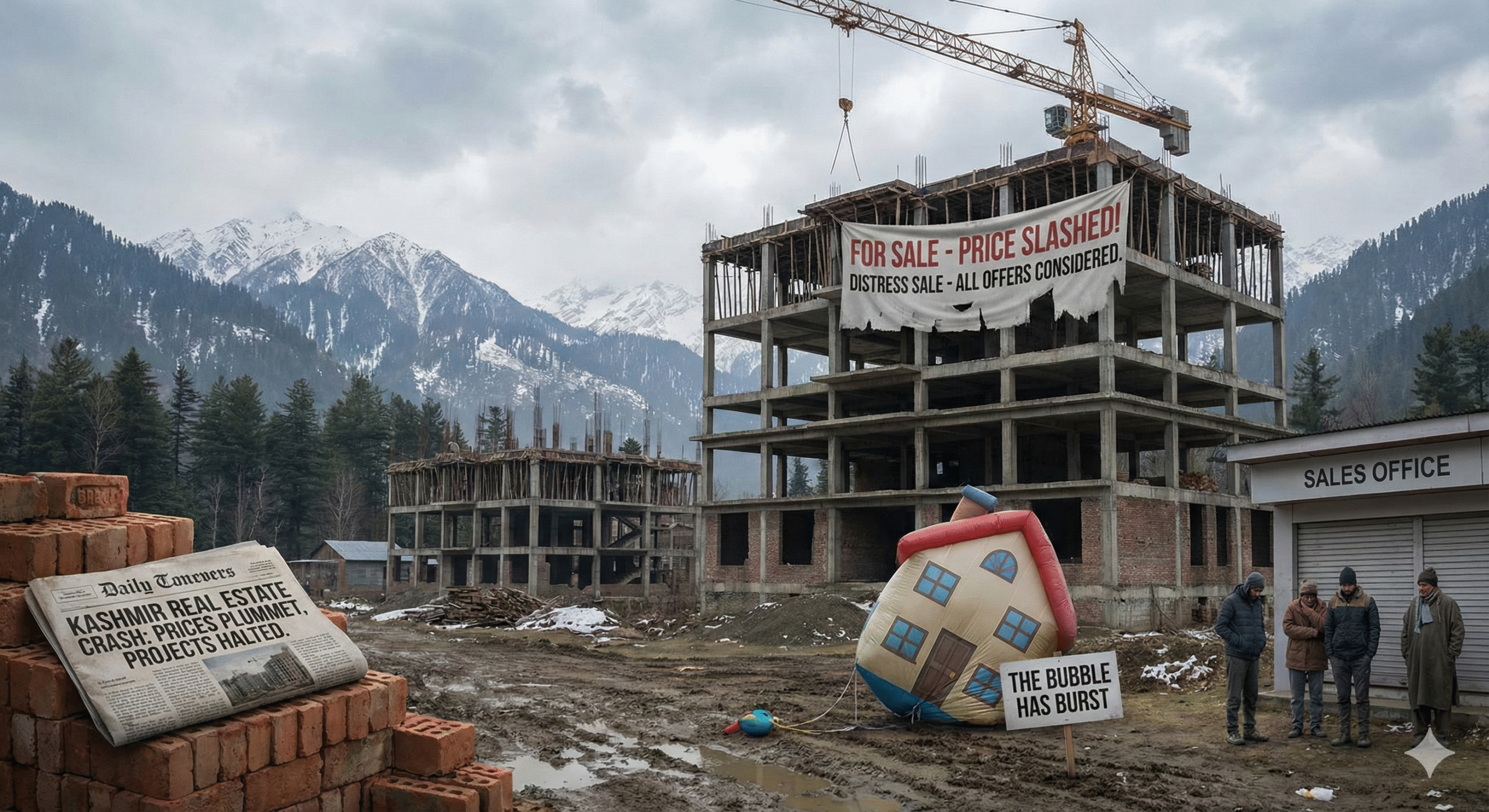
SRINAGAR — For decades, land in Kashmir was the one investment that never failed. It was the gold standard of stability in a region defined by uncertainty. But as winter approaches in late 2025, a chilling wind is blowing through the Valley’s property market, bringing with it a stark realization: the boom may be over.
Across Srinagar, the “For Sale” signs are multiplying, but the buyers have vanished. The economy, battered by a sudden slump in tourism and a freeze in construction, is facing one of its toughest tests in years.
The Deal That Never Happened
Nowhere is the crisis more visible than in the story of Muhammad Shafi*, a property broker in the Soura area of Srinagar. Nine months ago, Shafi purchased a modest house in Soura for Rs 96 lakh. It was a calculated gamble; in the heady days of 2023 and early 2024, he could have flipped it for Rs 1.10 crore within weeks.
Today, the house stands locked and empty.
“I have not had a single serious inquiry in four months,” says Shafi, whose capital is now trapped in the brick-and-mortar structure. “I am ready to sell at cost, maybe even a small loss, just to get my liquidity back. But there is simply no one with the cash to buy.”
Shafi’s story is not unique. It is the symptom of a market that has shifted violently from a seller’s paradise to a buyer’s graveyard.
A 30% Correction
Market insiders estimate that property values in prime residential areas have seen a correction of up to 30% over the last year. Properties that commanded Rs 1 crore in 2024 are now struggling to attract bids of Rs 70 lakh.
“The segment above Rs 1 crore is dead,” says Mubashir Bhat, a real estate analyst based in Rajbagh. “There is a severe liquidity crunch. The only movement we see is in the distress sale category—people who owe money to banks and are desperate to liquidate assets to avoid auctions.”
The Banking Distress
The user’s observation that “Bank NPAs are increasing” reflects a grim reality on the ground. While official bank balance sheets often show “managed” NPA ratios due to write-offs, the fresh slippages—loans turning bad—tell a different story.
Data from the latest quarter of FY 2025-26 indicates a worrying trend: Credit appetite has collapsed. The Credit-to-Deposit (CD) ratio in several districts has plummeted, signaling that businesses are too scared to borrow and banks are too scared to lend.
“We are seeing a surge in SARFAESI notices,” admits a senior manager at a leading public sector bank in Srinagar, speaking on condition of anonymity. “Many borrowers who took housing loans or commercial limits against property two years ago are now defaulting. The valuation of their collateral has dropped, but their debt remains the same. It is a trap.”
The “Wealth Effect” Evaporates
For years, the Kashmiri economy relied on the “wealth effect” of rising land prices. A family could sell a kanal of land and start a business, build a house, or send a child abroad. With land prices stagnating or falling, that safety net is gone.
Combined with the sharp dip in tourism bookings following the instability earlier this year, the cash flow in the market has dried up.
“Economy is a cycle,” says economist Prof. A.R. Khan. “When tourism bleeds, the hotelier suffers. When the hotelier suffers, he doesn’t buy land. When he doesn’t buy land, the broker, the mason, and the painter lose work. We are seeing that domino effect now.”
The Outlook
For brokers like Shafi in Soura, the wait continues. The narrative of “land never loses value” is being rewritten by harsh economic laws.
“We used to say land in Kashmir is like gold,” Shafi says, looking at the keys to the unsold house. “But gold you can sell in a minute. This? This is becoming a burden.”
Note: Names in the report have been changed or used generally to protect privacy.


