


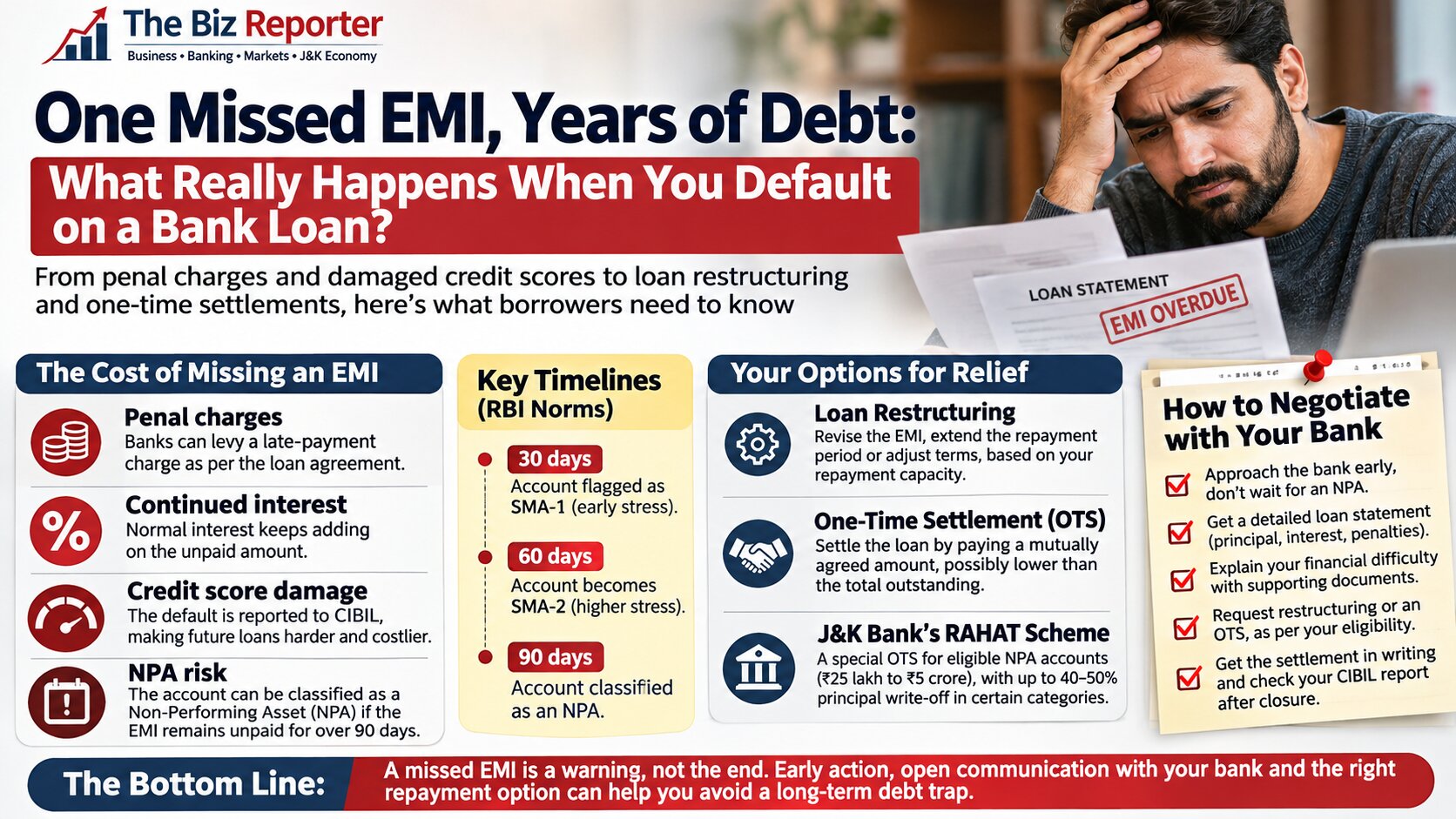
From penal charges and damaged credit scores to loan restructuring and one-time settlements, borrowers have several options — but delaying action can make recovery much harder
Firdous Ahmad
Srinagar: Missing a monthly loan instalment may appear to be a temporary financial setback. For a borrower struggling with reduced income, business losses, medical expenses or an unexpected emergency, one missed EMI can quickly turn into several months of unpaid dues.
But what many borrowers do not realise is that the consequences extend far beyond the immediate late-payment charge. A delayed instalment can affect their credit history, increase the outstanding liability, restrict access to future loans and, if the default continues, eventually lead to the account being classified as a Non-Performing Asset (NPA).
However, default does not necessarily mean that a borrower has run out of options. Banking regulations provide mechanisms for dealing with stressed accounts, including restructuring, repayment arrangements and One-Time Settlement (OTS).
Understanding when to approach the bank — and what options are available — can make a significant difference.
One missed EMI: When does the problem begin?
Under Reserve Bank of India (RBI) regulations, a loan instalment becomes overdue if it is not paid on its scheduled due date.
For a regular term loan, an account is generally classified as an NPA when the principal or interest instalment remains overdue for more than 90 days.
The classification, however, does not happen only after three months without any consequences.
The RBI’s prudential framework provides for progressive identification of stressed accounts. An account that remains continuously overdue is classified as a Special Mention Account (SMA), with SMA-1 applying after 30 days and SMA-2 after 60 days. It becomes an NPA when the overdue crosses 90 days, subject to applicable regulatory norms.
This means borrowers should not wait until their account becomes an NPA before approaching the bank.
The actual cost of missing an EMI
A missed EMI can create several financial consequences.
First, the bank may levy penal charges for non-compliance with the repayment terms. The RBI, through its August 2023 guidelines, significantly changed the way lenders can impose these charges.
Banks are no longer permitted to impose penalties in the form of additional penal interest added to the lending rate. Instead, such penalties must be treated as penal charges.
Importantly, penal charges cannot be capitalised, meaning banks cannot charge further interest on the penal charges themselves.
The charges must be reasonable, disclosed in the loan agreement and Key Fact Statement, and communicated to the borrower along with the reason for their imposition.
However, borrowers should understand an important distinction: the prohibition on charging interest on penal charges does not eliminate the normal contractual interest on unpaid dues. RBI has clarified that lenders may continue charging interest at the contracted rate on unpaid amounts, including unpaid EMI components, until the default is regularised.
Consequently, the outstanding liability can continue to grow even though the bank cannot compound penal charges.
How a missed EMI affects your CIBIL score
One of the most significant long-term consequences of loan default is its impact on the borrower’s credit profile.
Banks and financial institutions report repayment information to credit information companies, including TransUnion CIBIL.
A delayed EMI or non-payment can be reflected in the credit report as days past due (DPD). This repayment history is considered when lenders assess applications for future loans and credit cards.
The RBI’s 2025 credit information reporting directions require credit institutions to submit information on specified reporting dates during the month, including overdue accounts and changes in days past due.
Therefore, borrowers should not assume that a missed EMI will remain invisible until the account becomes an NPA.
A poor repayment history can make it difficult to obtain a home loan, vehicle loan, personal loan or business credit. Even when a lender is willing to approve a loan, the borrower may face less favourable terms.
There is no fixed number of CIBIL points that every borrower loses after missing an EMI. The impact depends on the individual’s existing credit history, the extent of the delay and other factors.
Loan restructuring: Can the bank reduce your EMI?
For borrowers facing genuine financial difficulties but who still have the capacity to repay, restructuring may be an alternative to allowing the account to deteriorate.
Restructuring involves modifying the existing repayment arrangement to make it more manageable.
Depending on the bank’s assessment and applicable regulatory framework, it may involve:
- Extending the repayment period.
- Revising the EMI amount.
- Changing the repayment schedule.
- Modifying interest-related terms where permitted.
- Providing other concessions based on the viability of the borrower.
For example, a borrower paying an EMI of Rs 35,000 may find it difficult to continue repayments after losing a major source of income.
Instead of allowing the account to accumulate overdue instalments, the borrower can approach the bank with financial records and request a revised repayment arrangement.
The bank will assess the borrower’s repayment capacity, financial position and viability before deciding whether restructuring can be considered.
Restructuring is not an automatic entitlement, and approval does not necessarily mean that the loan will immediately regain its previous standard classification.
One-Time Settlement: Can you close an old loan by paying less?
For borrowers whose accounts have already deteriorated into NPAs, One-Time Settlement (OTS) can provide another route to resolving outstanding liabilities.
Under an OTS, the bank and borrower negotiate a settlement amount to fully resolve the bank’s claims, potentially involving a waiver of part of the outstanding dues.
The RBI recognises compromise settlement as a legitimate mechanism for resolving stressed loan accounts. However, the decision must follow the bank’s approved policy and applicable regulatory safeguards.
A settlement should not be confused with ordinary loan closure.
When a borrower pays the entire contractual dues, the account is generally reported as closed. When the bank accepts less than the full amount payable and waives part of its claim, the account may be reported as settled.
This distinction matters.
According to TransUnion CIBIL, a settled status can adversely affect future borrowing prospects because lenders may view it as evidence that the borrower did not repay the original contractual liability in full.
Thus, while OTS can provide immediate relief from an unmanageable debt, borrowers should understand its implications for their future creditworthiness.
J&K Bank’s RAHAT Scheme: What relief is available to eligible borrowers?
An important example of a bank-led settlement mechanism is Jammu and Kashmir Bank’s Special One-Time Settlement Scheme, RAHAT (SOTS-2026).
The scheme provides eligible borrowers with an opportunity to settle certain stressed accounts involving principal NPA balances ranging from Rs 25 lakh to Rs 5 crore.
According to the scheme guidelines, the coverage includes specified Doubtful-I, Doubtful-II, Doubtful-III, Loss, Technical Write-Off (TWO) and RLA accounts, subject to eligibility conditions.
The principal outstanding is considered as on June 30, 2026.
For unsecured accounts, the scheme provides the following settlement structure:
| Account classification | Settlement amount | Principal write-off |
|---|---|---|
| Doubtful-I | 60% | 40% |
| Doubtful-II | 55% | 45% |
| Doubtful-III/Loss/TWO/RLA | 50% | 50% |
In addition, the scheme provides for full waiver of unapplied interest and legal and other charges for eligible unsecured accounts.
For secured accounts, the settlement amount is determined using the Net Present Value (NPV) of the tangible security and the prescribed formula. The settlement is therefore not simply a fixed percentage of the outstanding loan.
An example: How much can a borrower save?
Consider an illustrative borrower whose unsecured loan account has a principal NPA balance of Rs 25 lakh and is classified as Doubtful-I.
Under the RAHAT scheme:
- Principal NPA outstanding: Rs 25 lakh.
- Settlement amount: Rs 15 lakh.
- Permitted principal write-off: Rs 10 lakh.
- Unapplied interest and eligible legal and other charges: Full waiver.
In this hypothetical example, the borrower would settle the eligible account for Rs 15 lakh instead of the Rs 25 lakh principal NPA balance, subject to the scheme’s approval and conditions.
For a borrower whose account falls under Doubtful-II, the prescribed settlement amount would be Rs 13.75 lakh on the same principal balance.
For Doubtful-III, Loss, TWO or RLA accounts, it would be Rs 12.50 lakh.
These are illustrative calculations, not guaranteed settlement offers. Actual eligibility and settlement amounts must be determined by the bank.
Who can apply under RAHAT?
The scheme is subject to several conditions.
The principal NPA balance must be between Rs 25 lakh and Rs 5 crore as on June 30, 2026.
The account must generally have remained in the NPA category for at least one year. Where applicable, the prescribed SARFAESI proceedings must also have been initiated by June 30, 2026.
Accounts where restructuring or rehabilitation has failed may also be considered.
However, the scheme excludes certain categories, including accounts declared as wilful defaults or where fraud has been declared and reported to the RBI, staff NPA accounts subject to specified exceptions, and accounts below the minimum or above the maximum exposure limits.
The guidelines also contain provisions concerning government-guaranteed loans, accounts under investigation and other specified categories.
How much money must be deposited upfront?
RAHAT requires borrowers to deposit 15 per cent of the approved settlement amount at the time of submitting the application.
The remaining 85 per cent must ordinarily be deposited within three months of sanction.
An extension of up to another three months may be considered if the borrower deposits at least 50 per cent of the settlement amount within the initial three-month period. The balance would then carry interest at the six-month MCLR, as prescribed by the scheme.
The maximum payment period cannot exceed six months.
Failure to deposit the full settlement amount within the stipulated period can result in cancellation of the settlement. Amounts already deposited may then be appropriated towards normal recovery, and legal or recovery proceedings may resume.
The scheme guidelines state that it remains in force for three months from the date of circulation. Borrowers should confirm the applicable circulation date, current validity and individual eligibility directly with J&K Bank before applying.
What should borrowers do when they cannot pay their EMIs?
Financial experts generally advise borrowers to approach their lender before the situation becomes unmanageable.
There are several practical steps borrowers can take:
1. Do not ignore bank communications: Ignoring reminders, notices and recovery communications can complicate the situation.
2. Request a detailed loan statement: Ask the bank for a complete breakup of principal outstanding, regular interest, overdue interest, penal charges and other expenses.
3. Explain the financial difficulty: Submit relevant documents showing salary reduction, business losses, medical expenses or other circumstances affecting repayment capacity.
4. Explore restructuring first: If the borrower has a sustainable income and can repay over a longer period, a revised repayment schedule may be more appropriate than an OTS.
5. Negotiate an OTS where necessary: If the account has become an NPA and repayment of the entire liability is no longer feasible, request consideration under the bank’s applicable settlement policy.
6. Obtain written confirmation: Never rely solely on verbal assurances. Any settlement must be formally sanctioned, with the amount, payment deadline, waiver and consequences of non-payment clearly documented.
7. Check the credit report after settlement: Ensure that the bank has correctly reported the payment and account status to the credit information companies.
Borrowers who find incorrect charges or repayment entries in their credit reports can raise a dispute with the concerned credit bureau and lender.
The bottom line: Early action can prevent a bigger financial crisis
A missed EMI does not automatically make a borrower a wilful defaulter, nor does it mean that the borrower has permanently lost access to banking services.
But prolonged non-payment can create a chain of consequences — overdue interest, penal charges, damaged credit history, NPA classification and recovery proceedings.
For borrowers already trapped in old liabilities, restructuring and OTS mechanisms can offer a way forward. Schemes such as J&K Bank’s RAHAT demonstrate how banks can use negotiated settlements to resolve stressed accounts while providing eligible borrowers an opportunity to close old liabilities.
The most important lesson is simple: borrowers should not wait until recovery notices arrive or their accounts turn into NPAs. Approaching the bank early, understanding the actual liability and negotiating a documented repayment solution can prevent a temporary financial setback from becoming a long-term debt problem.


