


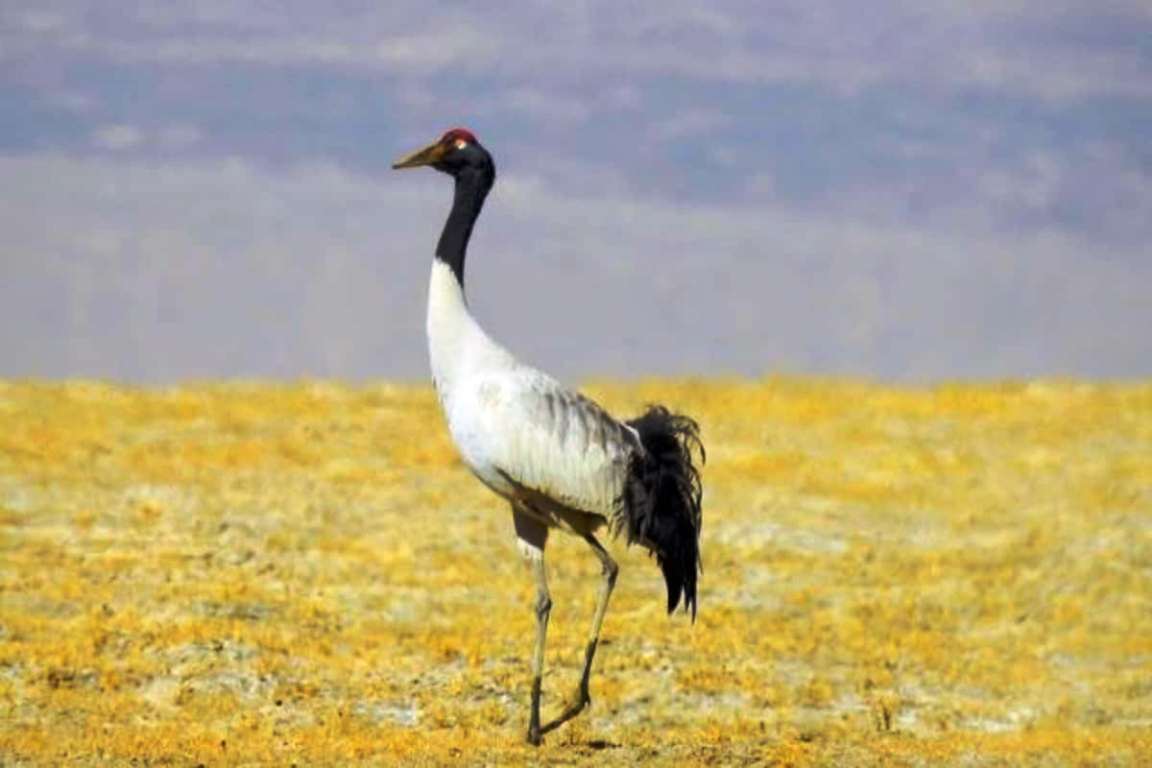
SRINAGAR: In the high-altitude wetlands of Ladakh, one of the most majestic yet rare birds, the black-necked crane, has found a haven. With sightings reported as high as 4,500 meters above sea level at Hanle in Ladakh, these migratory birds draw the attention of both conservationists and local communities.
Recognised globally, black-necked cranes are also found in small populations across Bhutan, China, and Nepal. In India, they are primarily seen in Ladakh, Sikkim, and Arunachal Pradesh.
Known as the “fairies of the plateau,” black-necked cranes are regarded as sacred symbols of wisdom, purity, good fortune, and longevity in Himalayan culture. These rare birds, with their elegant long legs and striking black-and-white feathers, gracefully roam the highlands.
The cultural significance of black-necked cranes further emphasises the importance of their conservation. The local Buddhist communities in the Changthang region regard these birds with reverence, and images of cranes frequently appear in traditional monastery paintings. The cranes are also a symbol of Ladakh’s natural heritage, proudly designated as the state bird.
A recent survey by the Wildlife Institute of India highlighted the fragility of this species, noting that the population in Ladakh stands at a vulnerable 66-69 individuals. In Arunachal Pradesh, only about 11 individuals have been documented during winter months.
The black-necked crane is listed under Schedule I of the Wildlife (Protection) Act, 1972, which accords the highest level of protection in India.
Changthang Wildlife Sanctuary in Ladakh is one of the primary breeding grounds for these cranes. The sanctuary is a vital habitat, offering these rare birds a secluded environment away from human disturbance.
This sanctuary is also home to the Indian Astronomical Observatory, with its powerful Himalayan Chandra Telescope, making it a site of interest for both wildlife enthusiasts and astronomers. However, the black-necked cranes face significant challenges, particularly from free-ranging dogs that roam near their nesting sites. Conservationists have observed that these dogs often pose a serious threat to the cranes by disrupting nesting grounds and preying on chicks.
This threat has been particularly noticeable in wetlands around Nyoma, Yaya Tsi, Tsokar, and Puga in Ladakh, where the cranes’ presence is at risk from canine disturbances.
One of the reasons for the increasing dog population is the availability of food waste discarded by large detachments of security forces stationed along the India-China border. This abundance of waste sustains the dogs and inadvertently fuels their numbers, creating a cycle that continues to impact the local wildlife. In previous years, measures were in place to guard the cranes’ nesting areas, but these efforts have reportedly decreased over time, making the birds more vulnerable.
The black-necked crane is a dedicated and monogamous species, forming lifelong pairs and usually raising one to two chicks each year. Standing tall at around 135 centimetres, these cranes have a distinctive grey plumage, black neck, and a striking red patch above their eyes. They are often seen in pairs or small family groups, wading through the wetlands along the River Indus, making them a captivating sight in Ladakh’s rugged landscape.
Efforts to protect these cranes are critical, as their population remains fragile and vulnerable to multiple threats. Conservation measures, including effective waste management and a renewed focus on guarding nesting sites, could play a pivotal role in ensuring that the black-necked crane continues to grace the high-altitude wetlands of Ladakh for generations to come.
Courtesy: Himalayan News Chronicle


