


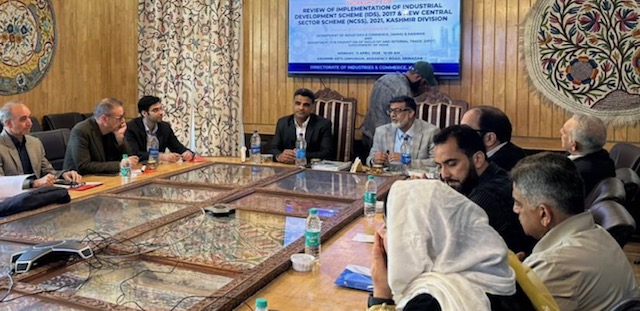
Srinagar: The Kashmir Chamber of Commerce & Industry (KCCI) participated in a high-level review meeting on the New Central Sector Scheme (NCSS) 2021 and the Industrial Development Scheme (IDS) 2017 for the Kashmir Division, held at the Kashmir Government Arts Emporium, Residency Road.
The meeting was chaired by Mr Rajesh Panwar, IES, Director, DPIIT, and attended by Mr Khalid Majeed (JKAS), Director Industries Kashmir, along with other senior officials. KCCI was represented by the Chairman of its Horticulture Sub-Committee, Mr Ashiq Hussain Shangloo, who presented a detailed account of ground-level challenges in the implementation of both schemes.
At the outset, Shangloo stated that KCCI appreciates the introduction of the Rs 28,400 crore NCSS. However, he highlighted that although the scheme remains valid until 2037, the registration window was abruptly closed on 30 September 2024, excluding many genuine entrepreneurs who were in the process of formalising their units. KCCI urged authorities to reopen or extend the registration window to ensure that deserving applicants are not denied benefits through no fault of their own. It also pointed to delays in departmental formalities, which have left numerous cases pending and added to uncertainty among industrial units.
The Chamber raised serious concerns over regional imbalance in the distribution of benefits. Of the 2,036 units registered before the deadline, only 953 have been granted eligibility. Out of the total outlay of Rs 28,400 crore, nearly Rs 20,098 crore is expected to be absorbed by a limited number of large industrial units, leaving a significantly smaller share for MSMEs.
KCCI observed that such concentration undermines the objective of inclusive industrial growth and called for a dedicated 25 per cent regional quota for Jammu & Kashmir to ensure equitable distribution. It further emphasised the Valley’s geographical disadvantage, noting that its landlocked nature significantly increases logistics and operational costs, which should be factored into policy design and benefit allocation.
Highlighting another key issue, KCCI said that existing MSMEs—considered the backbone of the region’s economy—remain largely excluded from the scheme’s benefits despite sustaining local employment through decades of adversity. The Chamber urged the government to devise a mechanism to extend incentives to these units and recommended that pending cases be granted at least 25 per cent of new benefits under any revised framework.
On policy design, KCCI strongly advocated for the integration of IDS 2017 and NCSS 2021 benefits, suggesting that provisions such as insurance and other incentives available under IDS be incorporated into NCSS to create a more comprehensive support structure.
Regarding financial outlay, the Chamber demanded that any extension of NCSS be accompanied by a substantial increase in allocation to Rs 75,000 crore. It argued that the current outlay has already proven inadequate given the scale of demand and the volume of pending cases, and that a significantly enhanced package is essential to drive meaningful industrial growth in Jammu & Kashmir.
KCCI stressed that any revision or restructuring of industrial schemes must follow meaningful stakeholder consultation. Policies framed without such engagement, it warned, risk deepening regional disparities and eroding the confidence of the entrepreneurial community.
The Chamber reiterated its commitment to working constructively with DPIIT, the Industries Department, and other stakeholders to ensure an industrial policy that is equitable, inclusive, and responsive to the needs of Jammu & Kashmir.


