


Tuba Bashir
Kashmir’s employment debate needs to be reframed.
The conventional narrative is that Jammu and Kashmir is struggling with unemployment because young people do not have jobs. That is only part of the story. A deeper and perhaps more troubling reality is that a large number of people who are described as “unemployed” are, in fact, working—but working for low wages, without adequate job security, predictable career progression or the dignity that should accompany employment.
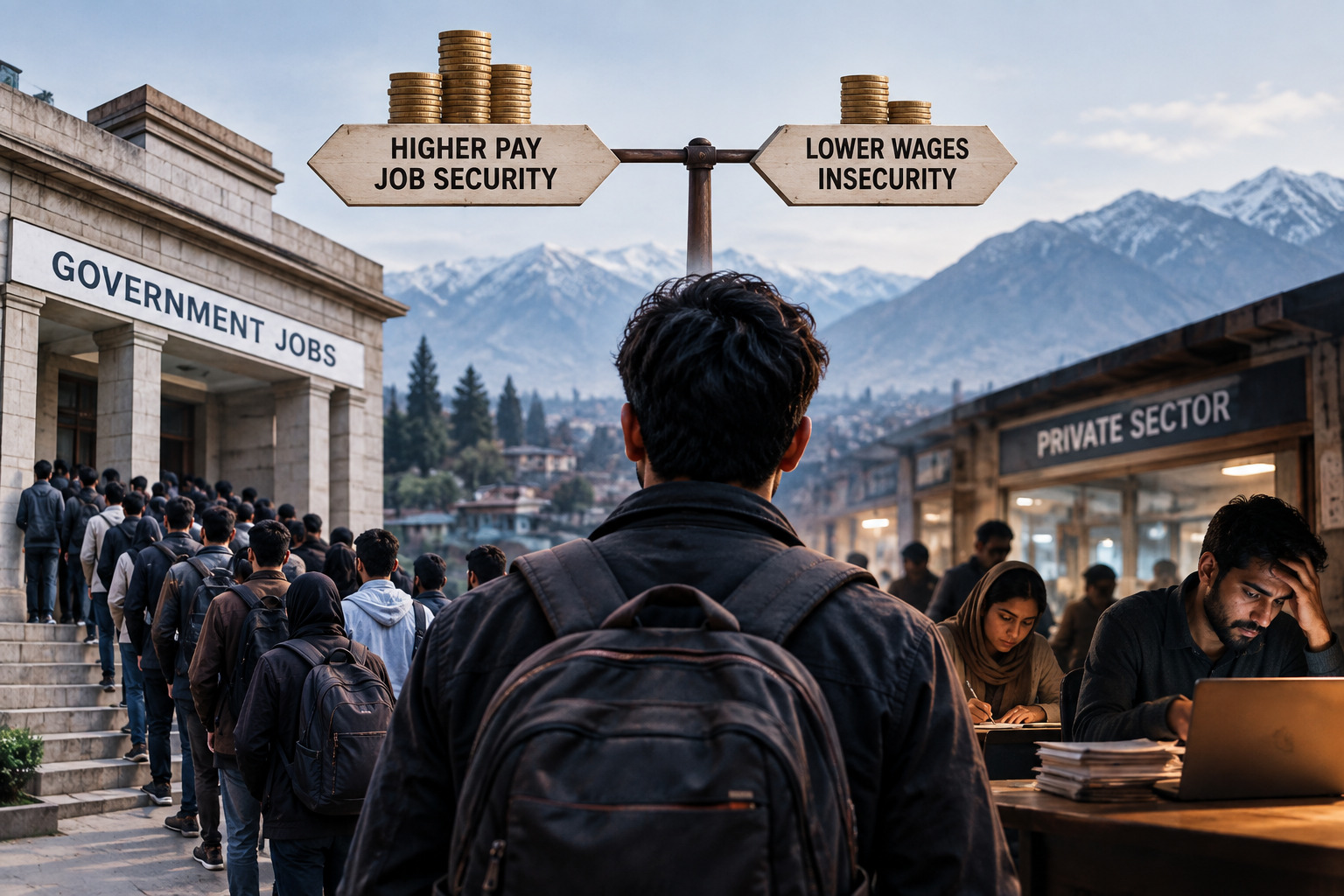
The queues outside government recruitment centres tell only half the story.
Look closely at the large recruitment processes conducted for government departments. Thousands, sometimes lakhs, of candidates apply for a limited number of posts. It would be easy to assume that all of them are unemployed. They are not.
Many are teachers in private schools. Many work in private companies, shops, hospitals, educational institutions, construction firms, banks, call centres and other establishments. They have jobs. What they do not have is a job that provides sufficient income, security and a reasonable expectation of a better future.
This is Kashmir’s real employment paradox: people are not necessarily looking for their first job. They are looking for a better job.
In much of the private sector, salaries for entry-level and lower-level employees remain in the range of roughly Rs 15,000 to Rs 25,000 a month. By comparison, a government employee entering service at an equivalent level can often expect a substantially higher overall compensation package, along with greater job security, structured increments, leave benefits, retirement-linked benefits and other protections.
That difference changes the entire psychology of employment.
For a young person earning Rs 18,000 or Rs 20,000 a month, a government recruitment notification is not merely an opportunity to change employers. It represents a possible transformation in economic security.
It means being able to plan a family. It means being able to pay rent, education expenses and medical bills with greater confidence. It means having paid leave, clearer service conditions and some assurance that the job will still exist several years from now.
This is why the obsession with government jobs cannot simply be dismissed as a preference for “secure jobs” or an unwillingness to work in the private sector.
The private sector is often asking people to work for considerably less while expecting flexibility, longer hours and greater availability.
The contrast becomes particularly visible in education.
Consider a private-school teacher and a government-school teacher performing broadly similar teaching responsibilities. Both enter classrooms. Both prepare lessons. Both assess students. Both deal with parents. Both attend meetings and perform administrative duties.
Yet their employment conditions can be dramatically different.
A private-school teacher may receive a relatively modest monthly salary and, in some institutions, may be expected to remain available during periods that are officially designated as school vacations. Summer vacations or winter breaks can involve workshops, meetings, training programmes or other assignments.
The government teacher, by contrast, operates within a much more clearly defined service structure, with established leave provisions, pay scales, increments and employment protections.
The argument here is not that government teachers should lose their rights or holidays. They should not.
The question is different: why should a private teacher doing comparable work be expected to accept substantially inferior wages and employment conditions?
If society considers teaching a profession deserving respect, then that respect cannot end at public-sector schools.
The same principle applies across the private sector.
A worker cannot be expected to deliver productivity, professionalism and loyalty while being paid wages that barely allow him or her to maintain a household. Nor can an economy claim to be creating quality employment merely because people are technically on someone’s payroll.
There is an important difference between employment and decent employment.
A person earning Rs 15,000 a month without security may be statistically employed. Economically and psychologically, however, that person may remain deeply insecure.
This is where the mental-health dimension of Kashmir’s employment debate deserves greater attention.
Constant financial uncertainty creates its own pressure. A young person may have a job but still worry about marriage, housing, children’s education, healthcare and the future. Every government recruitment notification then becomes a potential escape route.
The result is a peculiar cycle.
People take private jobs because they need income. They continue working because they cannot afford to remain unemployed. At the same time, they prepare for government examinations because their existing employment does not provide the security or income they need.
When they eventually leave their private jobs for a government position, the statistics may record another government appointment. But the underlying story is not necessarily job creation. It is labour moving from low-paid and insecure employment towards better-paid and more secure employment.
That distinction matters for policymaking.
If the government wants to address unemployment in a meaningful manner, simply creating more government posts cannot be the only answer. Nor is it financially sustainable to absorb every job seeker into the public sector.
The bigger challenge is to make private employment more attractive.
That requires stronger enforcement of minimum wage provisions, transparent employment contracts, timely payment of salaries, social-security protections, regulated working hours, paid leave, grievance mechanisms and genuine opportunities for career progression.
It also requires recognising that private-sector employers are not operating in a vacuum. If a qualified graduate can earn substantially more and enjoy greater security in a government job, the private sector will struggle to retain talent unless it offers a competitive employment proposition.
There is also a role for the government in creating a framework for regularisation and professionalisation in sectors such as private education, healthcare and other large employers.
Regularisation does not necessarily mean converting every private employee into a government employee.
It means establishing minimum standards below which employment should not fall.
A private teacher should know what salary he or she is entitled to, what working hours apply, what leave is available, what notice period governs termination and what mechanism exists to challenge arbitrary decisions.
An employee should not have to choose between accepting exploitative conditions and losing the only income available to the family.
Kashmir therefore needs to stop asking only one question: “How many jobs have been created?”
It should ask several more.
How many of those jobs pay a living wage?
How many provide employment security?
How many offer social protection?
How many provide career progression?
How many allow a young person to plan a future rather than merely survive from one month to the next?
And perhaps the most important question: are we creating employment, or merely creating workers who remain economically insecure?
The massive response to government recruitment drives is a message that policymakers should listen to carefully. It is not necessarily a rejection of the private sector. It is often a rejection of poorly paid and insecure employment.
Kashmir does not need an economy in which people are technically employed but permanently anxious about money and the future.
It needs an economy where a competent private-sector employee can earn enough, enjoy reasonable protections and see a future in the job without constantly waiting for the next government recruitment notification.
That is the employment challenge Kashmir must confront.
The question is not simply: Do you have a job?
The more important question is: Does your job allow you to live with dignity, security and peace of mind?
The Author is an economics student


