


The Biz Reporter
Srinagar, Nov 23:
Srinagar, Nov 23: The Environmental Policy Group (EPG) has expressed shock, deep concern and alarm over reports of heavy machinery operating near Sheshnag Lake, one of the fragile glacial lakes of the Himalayas, even as the migratory bird season has begun across Kashmir’s wetlands.
EPG Convener Faiz Bakshi said the reported use of heavy machinery in such an ecologically sensitive zone raises serious concerns about the safety of fragile mountain landscapes and the adequacy of environmental safeguards.
“Sheshnag is no ordinary water body. It is a glacial lake surrounded by loose moraine and steep slopes. It is already listed among the 14 high-risk glacial lakes in Jammu and Kashmir. Disturbing such terrain with heavy machinery is an invitation to disaster,” Bakshi said.
Referring to visuals circulating on social media showing an excavator cutting and levelling earth near the lake, Bakshi said the reported activity requires immediate scrutiny by the competent authorities. He called for a clear public explanation regarding the nature of the work, the agencies involved, the environmental safeguards adopted and whether the activity has been assessed for its potential impact on the fragile landscape.
He said any intervention in the vicinity of a glacial lake must be approached with extreme caution, given the vulnerability of such terrain to slope instability, erosion and other environmental risks.
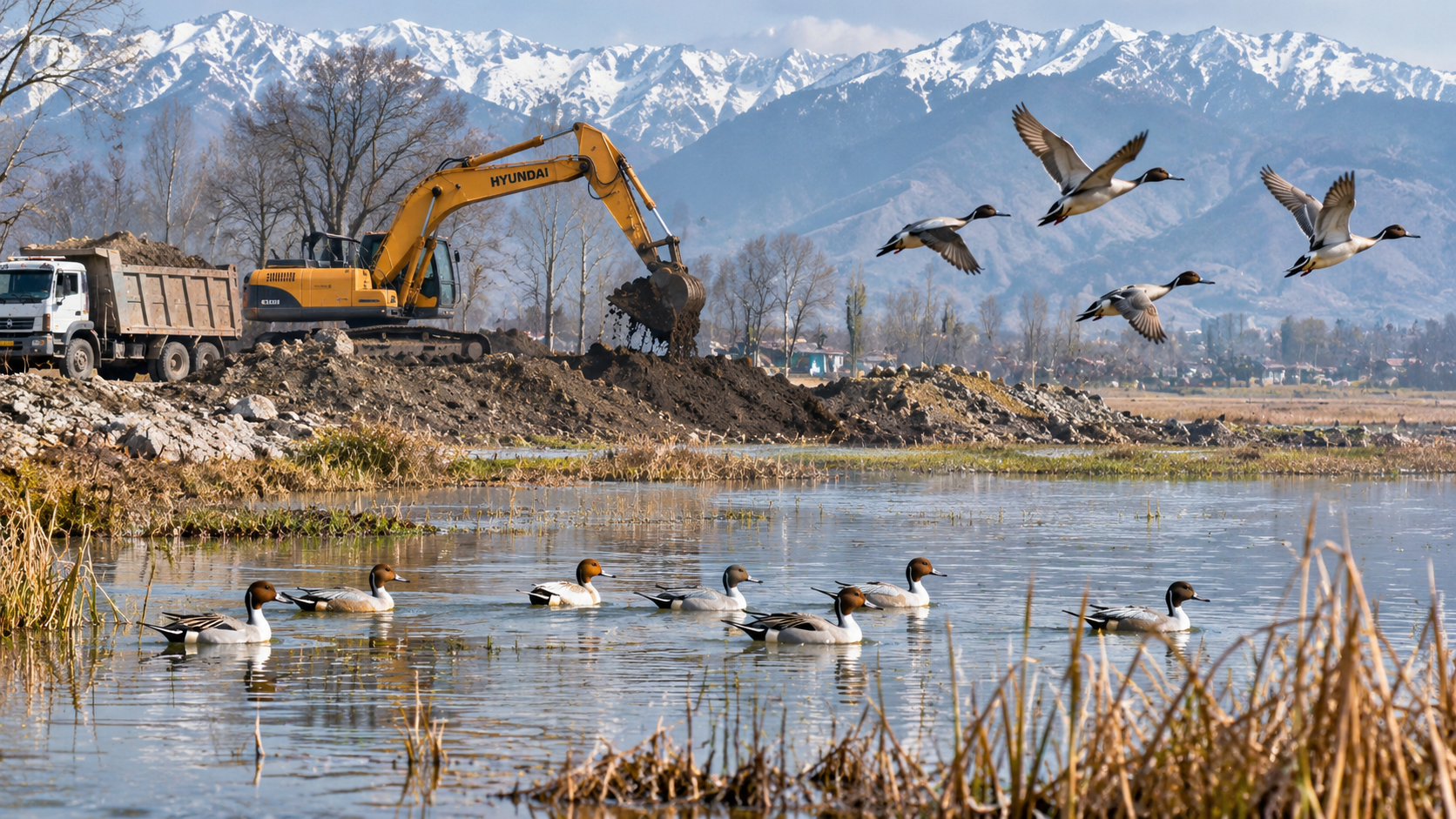
The EPG Convener said the concerns surrounding Sheshnag were part of a wider pattern of ecological stress affecting Kashmir’s wetlands, where reports of excavation and disturbance at Shallabugh have caused serious apprehension at a time when migratory birds are returning to the Valley.
Bakshi said Shallabugh, Hokersar and Hygam are important wetland habitats and internationally recognised ecological assets. Their conservation is essential not only for migratory birds but also for maintaining water systems, biodiversity and the environmental balance of the Kashmir Valley.
He said the timing of reported disturbances at Shallabugh was particularly concerning, as the migratory season places additional importance on the protection of feeding, resting and breeding habitats. Excavation, alteration of natural vegetation, disturbance of water flows and human activity in sensitive areas can affect the ecological conditions on which migratory birds depend.
“While migratory birds are arriving in Kashmir, the habitats that sustain them are facing mounting pressure. This contradiction should alarm every institution responsible for environmental protection,” Bakshi said.
The EPG said official and reported data point to a serious and persistent problem of encroachment across Kashmir’s wetland conservation reserves.
According to figures reported in a recent RTI-based assessment, 390.19 hectares of land have been encroached upon across six of the eight Wetland Conservation Reserves. The reported figures include 191.41 hectares at Hokersar, 95.85 hectares at Hygam, 89.74 hectares at Mirgund, 5.14 hectares at Freshkhoori, 4.24 hectares at Chattalum and 3.81 hectares at Shallabugh.
The assessment also reported that 1,001 eviction notices had been issued. However, the information did not provide a corresponding figure for the area of land actually retrieved following the notices.
Bakshi said the gap between issuing notices and restoring encroached wetland land raises questions about the effectiveness of enforcement.
“An eviction notice is not the same as ecological restoration. The real measure of action is whether the encroached land has been recovered, the natural habitat restored and the wetland’s ecological functions protected,” he said.
The EPG also expressed concern over the shortage of staff in the wetland management system. As reported in the RTI-based assessment, 43 of the 89 sanctioned positions in the Wetlands Division were vacant, leaving nearly half of the sanctioned posts unfilled.
Bakshi said such vacancies weaken field monitoring, enforcement, scientific assessment and the timely response to encroachment and habitat disturbance.
The EPG welcomed the National Green Tribunal’s continued scrutiny of wetland degradation in Jammu and Kashmir, while stressing that judicial intervention must be matched by effective action on the ground.
In its recent proceedings, the NGT sought a fresh report from the Jammu and Kashmir Pollution Control Committee, asking for wetland-wise details comparing the area recorded in revenue records with the actual existing area. The Tribunal had found the earlier submission incomplete, particularly because it did not clearly establish the present area of wetlands and certain district-wise details remained awaited.
The Tribunal has directed that the fresh report be filed ahead of the next hearing scheduled for February 26, 2027.
Bakshi said the NGT’s directions underline the need for accurate baseline data, transparent reporting and accountability in the management of wetlands.
He referred to broader evidence of wetland loss in Jammu and Kashmir. A reported assessment based on the EnviStats series indicated a decline of around 120 hectares in recorded wetland area over the period from 2006–07 to 2017–18.
The EPG also noted findings cited in a Comptroller and Auditor General audit, according to which 518 of 697 lakes listed in 1967 had either disappeared or shrunk. Of these, 315 were reported to have disappeared and 203 to have reduced in size, involving a combined area loss of 2,851.26 hectares.
Bakshi said these figures, though drawn from different reporting periods and assessments, collectively point to the urgent need for a comprehensive and scientifically grounded conservation strategy.
The EPG urged the concerned authorities to immediately examine the reported activity near Sheshnag Lake and the disturbances at Shallabugh, disclose the relevant facts and assess the ecological implications.
It called for strict monitoring of sensitive wetlands during the migratory season, restoration of encroached areas, improved staffing of wetland management institutions and a time-bound action plan to address pollution, siltation, altered water flows and habitat degradation.
Bakshi said Kashmir’s wetlands and glacial lakes must not be treated as expendable spaces for unregulated activity.
“These are living ecological systems. Once their natural balance is disturbed, the damage may be difficult, and in some cases impossible, to reverse. The protection of Sheshnag, Shallabugh, Hokersar, Hygam and other fragile habitats must be treated as an urgent public and environmental responsibility,” he said.


