


The Biz Reporter
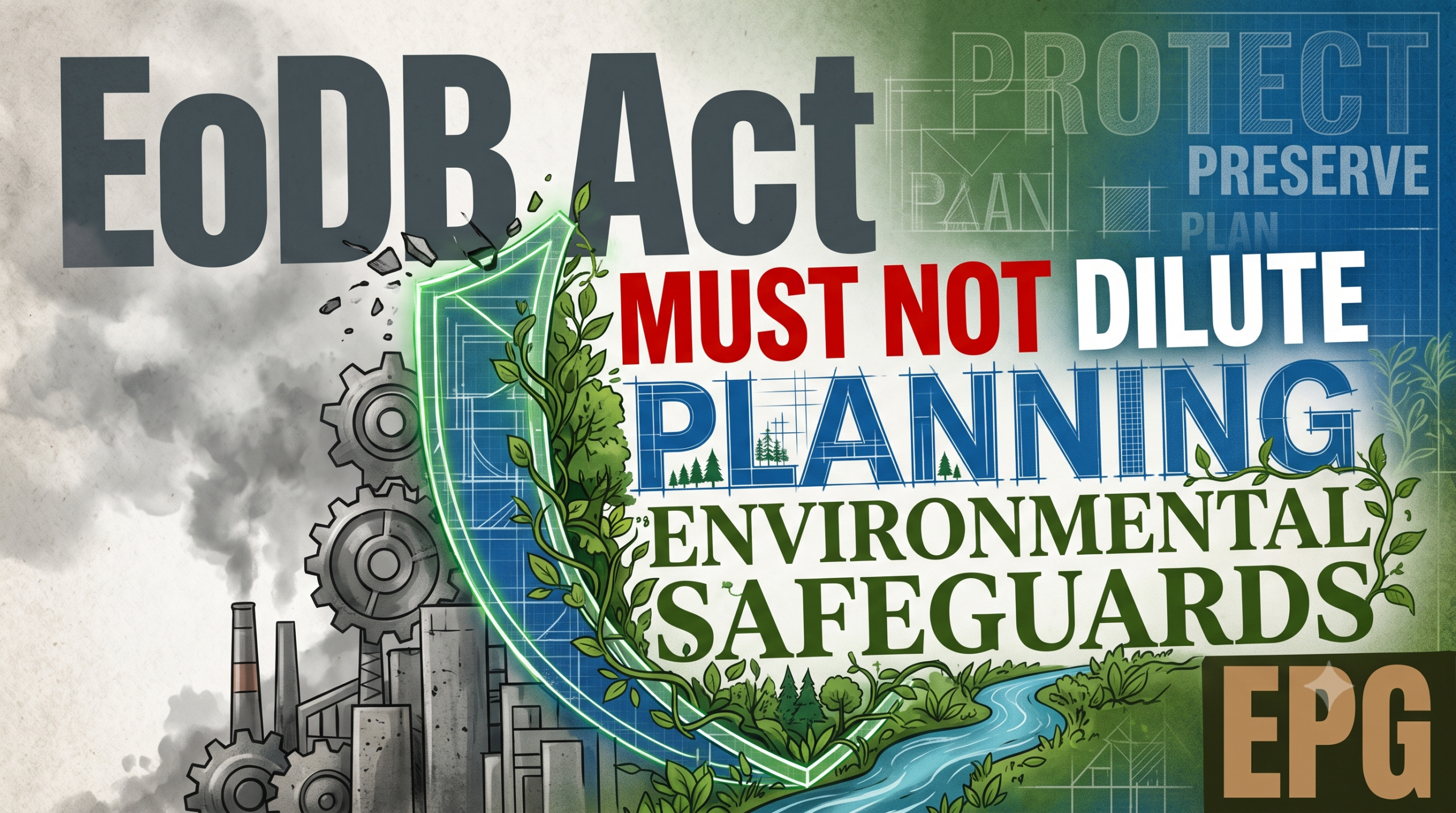
Srinagar: The Environment Policy Group has raised concerns over certain provisions of the Jammu & Kashmir Ease of Doing Business Act, 2026, particularly the scope of executive powers to relax or modify regulatory requirements, cautioning that efforts to streamline approvals should not weaken statutory planning, environmental safeguards or disaster-risk controls.
In a statement, the Group said it recognised the objective of the legislation, passed by the J&K Legislature and approved by the Lieutenant Governor, to simplify procedures, eliminate duplication, reduce delays and improve predictability for businesses and investors.
However, it said that in an ecologically sensitive and disaster-prone region such as J&K, regulation could not be viewed merely as an impediment to investment.
“Planning and environmental controls ensure that development remains compatible with carrying capacity and risk,” the Group said.
The Group identified Section 22 as its principal concern, particularly the breadth of powers relating to relaxation or modification of requirements. It said executive relaxation could potentially alter regulatory requirements without following the statutory planning process.
According to the Group, Master Plans and Zonal Plans are not routine permissions but represent spatial decisions based on land-use analysis, infrastructure requirements, environmental considerations, public consultation and long-term planning. Their dilution through executive exemptions, it said, could undermine the planning framework without formally amending the plans.
The Group also cautioned against any conflict between the EoDB framework and the statutory planning hierarchy established under the Jammu & Kashmir Development Act, 1970.
“EoDB must not override statutory spatial planning,” it said, warning that parallel systems—one governed by statutory plans and another by executive facilitation—could undermine regulatory certainty and predictability.
The Group stressed that J&K’s vulnerability to earthquakes, floods, landslides, unstable slopes, wetland loss and other hazards required development decisions to remain risk-informed.
It noted that the Srinagar Master Plan recognises flood-absorption basins, wetlands, seismic constraints and physical thresholds to urban growth.
“Development made easier without risk screening and location-specific safeguards could increase exposure of communities and infrastructure to disasters,” the Group said, adding that “Ease of Doing Business must not become Ease of Building Anywhere.”
On deemed approvals, the Group said time-bound clearances could significantly reduce administrative delays but argued that a distinction must be maintained between routine procedural matters and substantive planning, environmental and public-safety decisions.
It said proposals involving land-use changes, flood-absorption areas, wetlands, steep slopes, heritage areas, major infrastructure or other sensitive locations should not automatically receive approval merely because of administrative silence. Such proposals, it said, require appropriate risk assessment.
The Group welcomed the principle of risk-based regulation but said it must be genuinely risk-based, supported by clearly defined categories, objective thresholds, reliable spatial data and competent institutions.
It suggested integrating J&K’s GIS-based planning and disaster-risk capabilities into the EoDB workflow, with the level of scrutiny determined by the actual risk associated with a proposal.
On environmental safeguards, the Group said the legislation should clearly distinguish between redundant procedures and substantive regulatory protections.
“Duplication of clearances can be eliminated, but environmental, structural, fire, land-use and public-safety standards must remain enforceable,” it said, arguing that the objective should be “single-window regulation, not single-window deregulation.”
The Group also called for greater institutional accountability where powers of relaxation, deemed approval or exemption are exercised.
It said the Act should prescribe clear criteria, require written reasons, ensure public disclosure and provide review or appeal mechanisms. Without transparent standards, it cautioned, executive discretion could replace procedural delays with regulatory uncertainty.
The Group further emphasised the need for public consultation on significant changes affecting land use, development controls and environmental safeguards.
It said public participation was essential to legitimate planning and that executive changes without adequate disclosure, consultation and reasons could weaken public confidence in the planning process.
Referring to the experience of other States under the national Business Reform Action Plan, the Group said ease of doing business could be pursued through single-window systems, digitisation, time-bound approvals, online building permissions, rationalised inspections and risk-based scrutiny while retaining planning and building-control frameworks.
“The lesson is to simplify compliance without eliminating substantive controls,” it said.
The Group maintained that the EoDB framework could modernise and accelerate approvals without displacing Master Plans, Zonal Plans or building regulations, particularly where such controls address environmental sensitivity and disaster risk.
The Group said it did not question the need to remove unnecessary regulatory burdens, but stressed that a clear distinction must be maintained between genuine procedural reform and the weakening of essential public-interest regulation.
It called for implementation of the Act with safeguards protecting Master Plans, Zonal Plans, the Unified Building Bye-Laws, environmental regulations and risk-sensitive development controls.
“Section 22 warrants legal and planning scrutiny to ensure executive facilitation does not inadvertently override the planning framework,” it said.
“For J&K, the appropriate objective should be Ease of Doing Business through Better Regulation, rather than deregulation for its own sake,” the Group said, adding that economic development, environmental protection and disaster resilience could be mutually reinforcing when regulation is transparent, proportionate and risk-informed.
The Environment Policy Group said it was continuing its detailed examination of the Act and would place its recommendations before the Government and the public after completing the exercise.The report has been tightened for newspaper use, with the main news angle brought into the headline and lead, repetition reduced, and the technical concerns retained.


